
OUR METHODOLOGY
The R.O.C.K.E.T. Framework
A practical methodology for creating audience-centered presentations with clear structure, persuasive messaging and stronger visual impact.
Great ideas need structure before they can create impact.
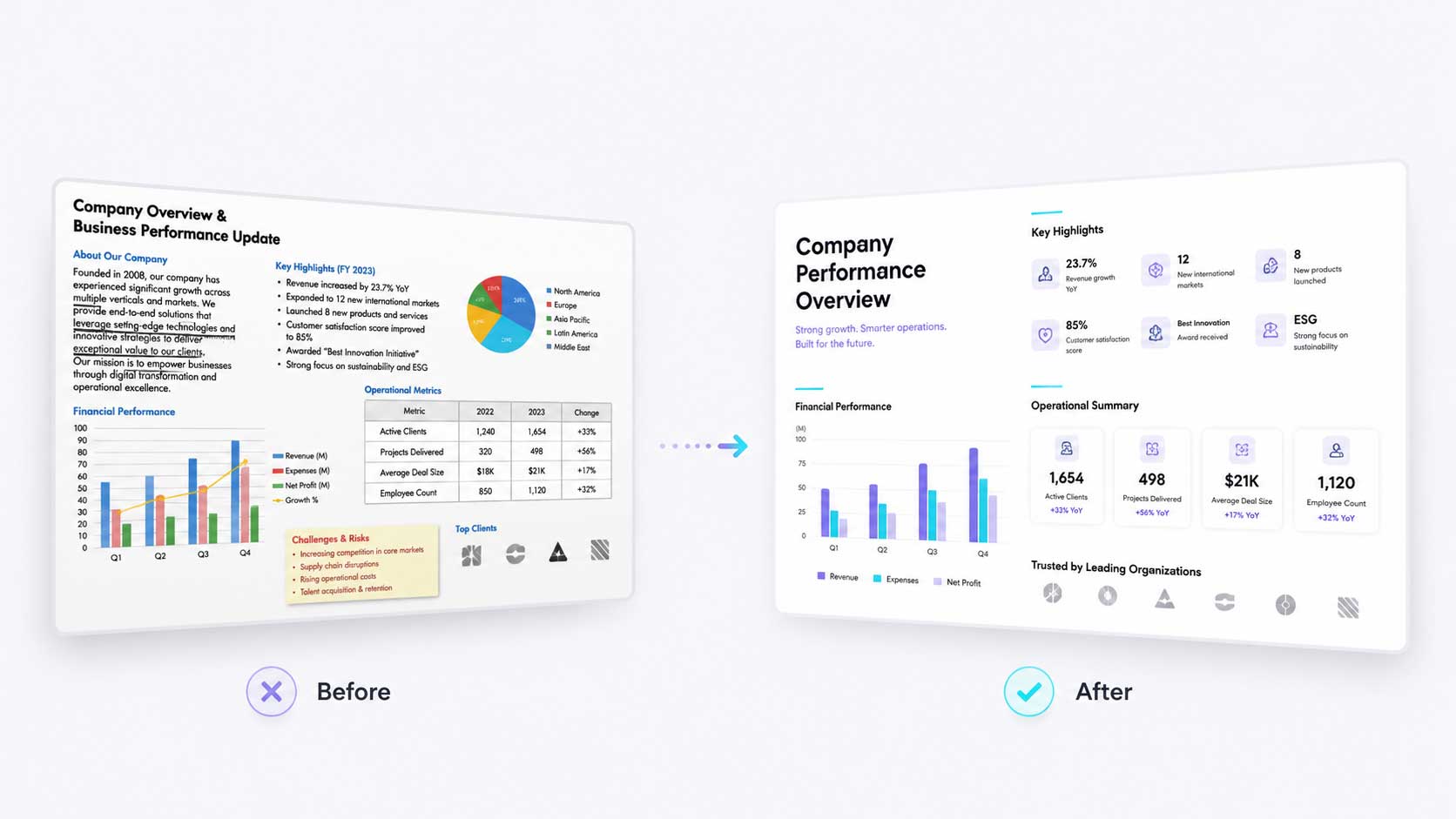
Many presentations fail not because the idea is weak, but because the message is unclear, the structure is fragmented or the slides create visual noise. The R.O.C.K.E.T. Framework helps teams turn complex information into presentations that are easier to follow, remember and act on.
The six steps of the R.O.C.K.E.T. Framework

Research
The first step in presentation design should be to make a research about your audience and learn more about who they are, what they think, what keeps them awake at night. Only by understanding your audience you will be able to persuade them

Organize
Then you need to organize your ideas under a central message so that they tell a compelling story. If your presentation does not have a concrete structure, then the audience will not be able to follow the flow of your narration and they will get lost. Thus, they will undermine your proposal

Consistency
Consistency in terms of design should be applied throughout the presentation. More specifically, the same style should be applied regarding fonts, lines, colors, shapes and images

Kill noise
A common mistake for those who use presentation software is to apply random formatting (shadows, colors, 3D etc.) that eventually leads only to visual noise. You should not decorate randomly your presentation but use the tools in an appropriate way to enhance your messages

Engage
Both in the narrative and in design you should attract and keep your audience’s attention

Test
When you finalize the presentation apply a quality control to confirm that everything works as expected and your messages are clear. After presentation delivery, you should measure the impact it made in your audience’s mind
R.O.C.K.E.T.
Download the R.O.C.K.E.T. Framework Guide
A practical guide to help you structure audience-centered presentations with clear narrative and stronger visual impact.
Understand your audience before building your slides
Structure your message around one central idea
Reduce visual noise and improve clarity
Create presentations that are easier to follow and remember
High-stakes presentations, designed to persuade.